It’s been a long, busy year, and I’ve written a lot of short fiction and thought a lot about novels, but as is the way with publishing none of that is out yet. Instead I had three science fiction short stories come out, all written one or two years previously, all in great venues. I’m immensely proud of all three—though I think if I had to pick one “Any Percent” has my heart. If you participate in nominating for or voting in any of the SFF awards (the Hugos, Nebulas, Locus, etc.), I would be honored to have your support for my work.

Any PercentGiganotosaurus. (Give it a like on the Nebula Reading List.)

A gritty cyberprole drama about speedrunning and solidarity in a video game where you can live any human life.

Mechanically, the way he did whenever he needed to escape the bleakness of IRL, Luckless daubed gel onto his temples, closed his eyes, and held START. When he opened them, her small, brown hands were stocking cans on grocery shelves. It was her birthday, of course, but she was mostly worried about when she’d find time to study for her GED, how late the buses were running after midnight, whether her mother had been sober enough to feed baby Diwa before bed. The algo in her earbuds beeped at her to pick up the pace.

Normally, Luckless would drop the can, shed the earbuds, steal a car, and head to the nearest skip he could remember. Tonight she was in Columbus, so Ohio Truck Skip wasn’t far. From there it would be routine to buy her way into the underworld, get a new identity that could make money moves, never have to do manual labor or think about where she came from ever again.

In her back, her feet, her arms, she felt that deep-bone tired. The same tired Luckless felt every day of that one, unskippable life.

She finished work and rode the bus home, nursed her baby, and slept. The next morning she got out early, went to the diner across from the grocery, where a few of her coworkers were gathering to talk about organizing a union.

The Uncool HuntersEscape Pod podcast. (Nebula Reading List link.)

A fun, ‘high capitalist‘ comedy caper about two creative consultants duking it out in an Illinois Costco.

Before she settled down into publishing in Minneapolis, before she got taken for a ride by the Chicago AltNormLit scene, before she flared spectacularly out of Silicon Alley, and had her pilot shoot C&Ded by the City of Santa Barbara, and narrowly avoided cryptocollar prison in the floodzone formerly known as Tampa, Rocky Cornelius was a fucking uncool hunter.

“Family Business” (with Corey J. White) — Analog Magazine. (NRL)

A multigenerational dramedy set in the climate repair industry—featuring carbon offset scams, ancestor AIs, and striking dolphins.

“Why not send some drone submersibles down there to check the seals ourselves? The only reason we use dolphins is because Aunt Eudy was an absolute freak.”

“Well, zir, that is the other piece of bad news. Our subcontractors did send drones. But, you see zir, the dolphins destroyed the drones before they could reach the reservoir. I’ve seen the footage. They are…very violent.”

Rory got up and paced circles, their vat-leather Louis Vitton boat shoes squeaking on the polished wood.

“I’m not going to ask how,” they announced. “I really don’t want to know. What I do want to know is, where did they get these ideas? Who’s been salting these fishes?”

“Researchers, zir, working to advance interspecies cultural exchange. Apparently very few human concepts were of interest to the dolphins until the researchers tried explaining dialectical materialism.”

Thank you so much for your consideration!

I have a short story out in the November/December issue of Analog Magazine! Co-written with Australian SF writer Corey J. White, “Family Business” is the story of seven generations of the Weathersmith family, charting their rise and fall and rise and fall in the carbon removal industry. It features offset accounting scams, undersea engineering, ancestor AIs, and messy family drama.

Here’s an excerpt from about halfway into the story, when Rory (5ish generations in) finds out their dolphin employees have gone on strike:

“Why not send some drone submersibles down there to check the seals ourselves? The only reason we use dolphins is because Aunt Eudy was an absolute freak.”

“Well, zir, that is the other piece of bad news. Our subcontractors did send drones. But, you see zir, the dolphins destroyed the drones before they could reach the reservoir. I’ve seen the footage. They are…very violent.”

Rory got up and paced circles, their vat-leather Louis Vitton boat shoes squeaking on the polished wood.

“I’m not going to ask how,” they announced. “I really don’t want to know. What I do want to know is, where did they get these ideas? Who’s been salting these fishes?”

“Researchers, zir, working to advance interspecies cultural exchange. Apparently very few human concepts were of interest to the dolphins until the researchers tried explaining dialectical materialism.”

If you want to hear me talk about carbon removal and climate repair as a real world prospect, I recently had a lot of fun going into it on the Pullback podcast here.

This is my second story I’ve published with CJW, but it’s actually the first one we wrote together. It’s also the first time either of us has been published in Analog, which is one of the biggest and most storied SF magazines out there. Super excited to have this story out there!

So please, give it a read by supporting Analog with a print or digital subscription (a year’s digital subscription is only $6!!). You may also be able to find copies in some bookstores——not positive but I think Analog is one of the SFF mags carried on magazine racks at Barnes & Noble. It should look like this:

Two market researchers in a high capitalist future walk into an Illinois Costco and decide that the big box isn’t big enough for the both of them. That’s the premise of my latest short story, “The Uncool Hunters,” which premiered last week on Escape Pod, episode 894. You can read it on their website or listen to it wherever you get your podcasts.

Here’s the opening graf:

Before she settled down into publishing in Minneapolis, before she got taken for a ride by the Chicago AltNormLit scene, before she flared spectacularly out of Silicon Alley, and had her pilot shoot C&Ded by the City of Santa Barbara, and narrowly avoided cryptocollar prison in the floodzone formerly known as Tampa, Rocky Cornelius was a fucking uncool hunter.

I also wrote about the rather intense thinking behind this rather silly story in my newsletter, solarshardes.club.

I hope to be publishing more of Rocky Cornelius’s various adventures as a creative consultant, but in the meantime, I’m stoked for this story to be out in the world. Give it a read!

Happy May Day! Last year to celebrate International Workers’ Day, I shared a full story on my newsletter, solarshades.club. Titled “May Day” of course, it’s about what happens when a pair of groundhogging immortals start bringing more people into their time loop. It’s one of my favorite short stories I’ve written, falling squarely into the genre niche I’ve come to call ‘socialist surrealism.’ So I’ve decided to make posting a proletarian-themed story a May 1st tradition.

This year my May Day story is titled “Any Percent,” and it just went live on the storied online webzine Giganotosaurus. Imagine you could play a video game that let you live a whole human life in a matter of minutes. What would it mean to “win” in that game? What would it mean to speedrun?

Click through and give it a read. Here’s a short excerpt, from a ways into the story.

Mechanically, the way he did whenever he needed to escape the bleakness of IRL, Luckless daubed gel onto his temples, closed his eyes, and held START. When he opened them, her small, brown hands were stocking cans on grocery shelves. It was her birthday, of course, but she was mostly worried about when she’d find time to study for her GED, how late the buses were running after midnight, whether her mother had been sober enough to feed baby Diwa before bed. The algo in her earbuds beeped at her to pick up the pace.

Normally, Luckless would drop the can, shed the earbuds, steal a car, and head to the nearest skip he could remember. Tonight she was in Columbus, so Ohio Truck Skip wasn’t far. From there it would be routine to buy her way into the underworld, get a new identity that could make money moves, never have to do manual labor or think about where she came from ever again.

In her back, her feet, her arms, she felt that deep-bone tired. The same tired Luckless felt every day of that one, unskippable life.

She finished work and rode the bus home, nursed her baby, and slept. The next morning she got out early, went to the diner across from the grocery, where a few of her coworkers were gathering to talk about organizing a union.

Read the full piece in all its gamer glory here.

Today my friends at the Open Air Collective posted my short story “The Co2lector” as the first in their “Carbon Punk” fiction series exploring different possible futures of carbon dioxide removal and climate repair. This was a fun story to write, exploring an entrepreneurial character trying to navigate an overly complicated, but better-than-nothing world of CDR technology and policy. I consider it predictive rather than proscriptive, hopefully offering some insight into the way this nascent industry might evolve and grow amidst a shifting economic, political, social, and energy landscape. We can do much better than this market-driven mess the story draws, but hopefully we can also enjoy this tale of Raf’s precarious hustle.

If you aren’t plugged into this “climate repair” tip I’ve been on, this story is a good place to start, perhaps read in concert with my recent Jacobin debut: Zero Emissions Isn’t Enough. ​We Need Climate Repair. I’ve also mused a bit about this “civilizational project” on my newsletter, solarshades.club. And of course there was a chunk of speculation about carbon removal in my book. Most importantly to note: climate repair/carbon removal is not technofix replacements for deep decarbonization. Rather I think it is a necessary next step to restoring a stable and habitable world, one to be powered by clean, renewable energy and regenerative land use practices.

What is “carbonpunk”? For me it is sci-fi that imagines the street-level, burner phone version of a particular slab of technological futurity, that of machines, industry, and other practices meant to clean up the carbon waste with which we’ve wrecked the atmosphere (and, increasingly, the oceans). It kicks us into the complexities of living through that upheaval, and pushes us to consider just how evenly (or unevenly) distributed and in-our-lives such futurity can get.

More to come from me on this topic, no doubt.

I spent most of 2021 working on novels, editing, slushing, getting stoked about my book release next year, and miscellaneous projects. But I was also lucky enough to have four (4) short stories published (and a few reprints!). So below is my eligibility post (here’s a Twitter thread version as well). I would be honored if others in the SFF community read any of these stories and considered nominating them for the Hugos, the Nebulas, or any other annual award.

Short Stories

A Smell of Jet Fuel” — Lightspeed Magazine #134. Author spotlight. Nebula Reading List link.

We met on the 107th floor of the South Tower. She was standing in quiet contemplation, watching fire spread through the building across the plaza, smoke and paper billowing out into that baby blue sky. I was nursing a thunderous hangover, neglecting my tour group, which had all gone to the southern side of the observation deck to watch the second plane’s approach. She wasn’t supposed to be here.

A modern homage to Ray Bradbury’s classic “A Sound of Thunder,” featuring a time travel tour to the WTC on 9/11/2001 that doesn’t go quite as planned…

Solarshades” — Cities of Light. Nebula Reading List link.

On cloud-out days, when that listless Pacific smother hung low over Portland, and the house batteries chirped their plaintive ten-percent forebodings—the grid no help at all—Kismet clambered onto the roof to see the lit-up glitter of the Clackamas County line: a trash-strewn no-man’s land cutting through brownfields, fallow-forests, and cemeteries. A little crack in the law that neither Happy Valley nor Pleasant Valley wanted to deal with.

Kismet didn’t envy the refugees, undocs, and homeless who pitched their tents and parked their RVs in the interstices. But seeing their pyramids of warm glow, hearing their music, whiffing their smelly foreign food—all while his games were forced off and his showers ran cold and his cousins ate dry cereal and squabbled over flashlights—on those days he couldn’t help but feel a little drip of resentment runneling into his soul.

It’s a story of a Green New Deal and its discontents. Can an encounter with state-seeing AR glasses change Kismet’s perspective and help him organize for energy amnesty in his community before he’s drawn into his brother’s world of hate and small violence?

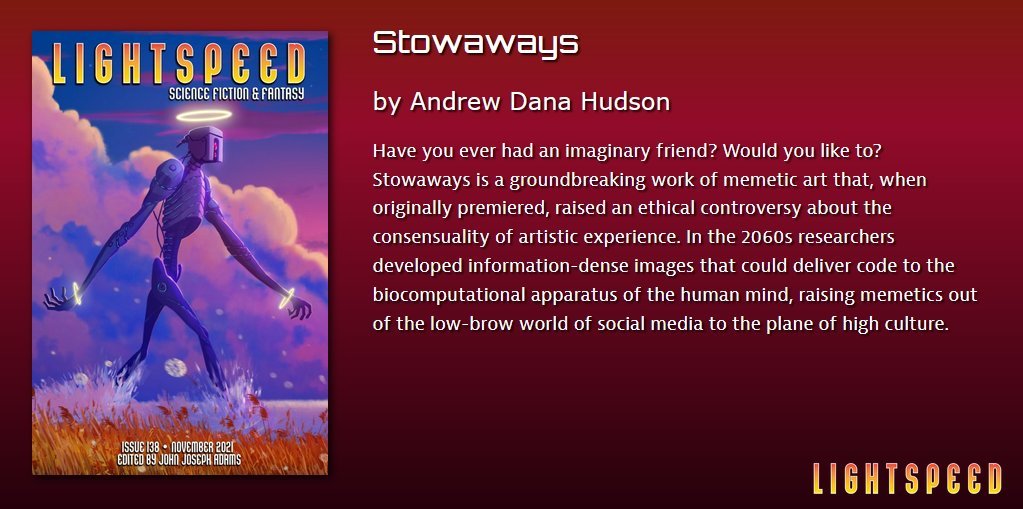
Stowaways” — Lightspeed Magazine #138

Special Exhibit
Making Aliens of Us: The Collected Works of FLOAT
Title: Stowaways, 2081
Inkjet print, forming memetic code, arranged behind curtain
Artist: FLOAT, Netherlands, 2040 – 2133
On lend from the Foundation for the Preservation of Troubling Artwork
**Please read this card in its entirety before proceeding**

Have you ever had an imaginary friend? Would you like to?

A flash piece about art, memes, and infohazards.

“The Painter and the Flatiron” — Cities in a Wild Garden: Stories of the Nature of Cities, Volume 2

The elephant who visited most often was a painter who lived on the Upper East Side. She’d walk down Park Avenue, swerving into museums for inspiration, canvases slung across her back. Then she’d post up in Central Park, where she’d sketch scenes everyone knew but which seemed, through her distinguished eye, freshly poignant.

She painted big and little cats sleeping in sunbeams; joggers racing Savannatown zebras; children climbing trellises to treehouses; permaculture wonks plotting in the gardens; lovers sharing picnic blankets; revolutionary working groups debating policy in the squares; critters perched on park benches, watching skateboarders try tricks by the statues; orangutans working public orchards, swinging from fruit trees, laughing on their lunch breaks.

Another flash piece, this one about tolerance and connection in a multispecies vision of New York City.

Thanks for reading this year! You can follow my work via Substack at solarshades.club.

Image

I have a flash fiction piece about art and memes out in Lightspeed Magazine today: “Stowaways.” It’s in the form of a pretentious gallery description card. You know, the thing you have to lean close to the wall and squint at to read, that gives you a semi-enlightening, semi-inscrutable short history of the attached painting or other artwork. This one, however, has a creepy twist.

I wrote the first version of this several years ago when I was solicited by someone putting together a compendium of ‘impossible works of art.’ I came up with three, this being the weirdest. One of the other ideas birthed my Pushcart Prize-nominated story “Black Ice City,” published in Glass and Gardens: Solarpunk Winters.

The idea of “nucleated” and “unnucleated” brains hosting “memetic intelligences” however goes back to a novel idea I had as a wee college student way back in 2007, when I was studying abroad in Kalimpong, India. The story was about Memento-memoried people living in cloud cities on Venus, waiting for in limbo while a centuries-long terraforming process unfolded. I’m still amazed at how many ideas I had that fall, when I had no easy access to TV or internet and spent most of my time drinking chai, journaling, and staring out at the rolling, foggy Himalayan foothills. The title of that never-written novel (which, who knows, maybe I’ll one day write) was Float, which in this story lends its name to the future artist who created Stowaways.

I’m quite fond of this weird little story, and I’m very glad that (after racking up many, many rejections) it has finally found a home.

My first short story collection is out this week from Future Fiction. This is an Italian-language collection that came into being thanks to Rome-based sci-fi writer/editor Francesco Verso, who had my stories translated from English. Nonetheless it is the first and most comprehensive collection of my short stories available anywhere, and I’m very proud of it. The book contains fifteen stories, including one that has never been published in English.

Sci-fi great Kim Stanley Robinson was kind enough to read the manuscript in English and offer the following advance praise:

“Hudson has found a way to strike together all the various facets of our rapidly changing climate future, sparking stories that are by turns ingenious, energetic, provocative, and soulful.”

Kim Stanley Robinson

And Francesco has this blurb (translated from Italian):

“Andrew Dana Hudson tells realities that don’t exist as if they were already here. And he describes them with a certainty and insight that are found only in a few other authors, such as William Gibson. If cyberpunk has exhausted its science fiction charge, grafting itself in a dangerously natural way into the fabric of global post-capitalism, it is due to authors like Andrew Dana Hudson who have made this genre obsolete by laying the foundations (or rather by sowing the seeds) of alternative futures through solarpunk. “

Francesco Verso

Buy it in the US in paperback or Kindle here.

Cover illustration by Paolo Castelluccio

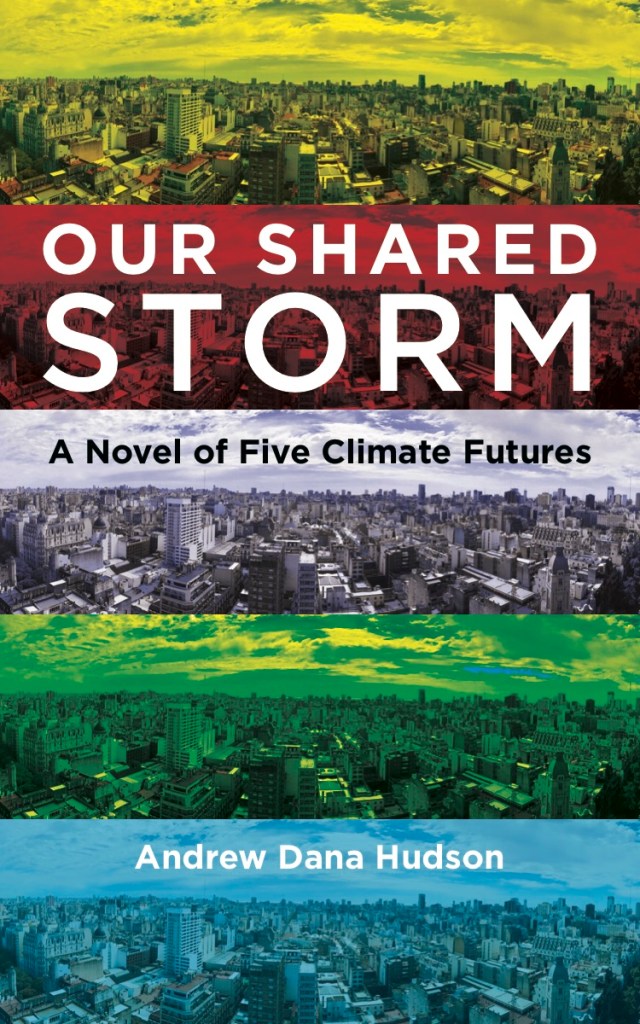
My debut book now has a cover and a release date! Our Shared Storm: A Novel of Five Climate Futures will be published April 5, 2022 from Fordham University Press. It’s already listed for preorder on most book retailers websites, or direct from the publisher here.

Our Shared Storm is a cli-fi fix-up novel that explores five different potential futures inspired by the IPCC’s Shared Socioeconomic Pathways scenarios. The five stories are set in 2056 at the United Nations climate negotiations (the Conference of the Parties, a.k.a. the COP), but in each scenario the conference, the characters, and the world have been shaped by diverging future histories. Exploring themes of mediocrity, economic growth, inequality, fragmentation, and sustainability, each story has its own twists and turns as our core characters meet each other anew, each as different people living different lives. The five stories knit together into a single narrative whole that explores the the collective choices we will have to make in the coming three decades.

The book also features an afterword about the nature and uses of climate fiction, and proposes a new theoretical formulation of “post-normal fiction.” Feel free to get in touch if you are a teacher interested in climate fiction and are considering using the text for a class.

If any of this sounds interesting, preordering your copy now would be a big help. Or have your local bookstore reserve you a copy!

Image

My story “A Smell of Jet Fuel” is out in Lightspeed Magazine #134!

Future time travel tourists visit the World Trade Center to observe the Sept. 11 attacks, but for Brad the tour guide not everything goes as planned. This story is an homage to Ray Bradbury’s classic “A Sound of Thunder,” about time travelers who hunt dinosaurs in the Jurassic. I talk more about this inspiration (and 9/11) in this interview. If you happen to nominate for the Hugo or Nebula awards, I’d be obliged if you considered this story come awards season and/or gave it an upvote on the Nebula Reading List.