

In 2023 I spent half the year living in Northern Sweden, working on a project at Luleå University of Technology. The project involved a series of narrative hack-a-thons, which then inspired four climate fiction stories by me about the future of energy in the region, along with a set of lovely illustrations by Daniel Bjerneholt, and a series of public engagements by my colleagues at LTU, RI.SE, and the Arctic Center for Energy. Now the stories have been collected together with contextual non-fiction and methodological reflections into a slick looking book — Northern Lights: Four Energy Futures of the North.
Edited by Anna Krook-Riekkola and Johan Granberg, the book features a lovely foreword by Clark Miller and contributions from colleagues Sara Bargi and Maria Håkansson. As a whole, it’s a really interesting and unique text in which all of us grapple with the complexity of the energy transition and how we communicate about it. If you are interested in trying out the narrative hack-a-thon methodology for futures development, there’s a lot of valuable lessons learned contained within.
The energy transition is a hot topic in Northern Sweden, where cities like Luleå and Skellefteå have been embracing green industry and anticipating significant energy system and social changes as a result. People there are thoughtfully considering how to navigate those changes, including the influx of people they may bring and the nuances of large scale deployments of wind power. It’s a chance to reimagine what communities in the north look like and what the region’s relationship should be to the rest of Sweden.
You can get the book as a free pdf, and soon we will have some print copies available.
You can also read the stories individually on the Luleå University of Technology (LTU) website.
Here’s a quick breakdown of each story, with the corresponding illustration and a short excerpt:
Windy City

“Windy City” is set in a bustling and prosperous far north metropolis, where wooden skyscrapers look out on giant wind turbines that are also significant tourist attractions. The story is a summertime caper about two moms trying to game a highly financialized energy system — and getting caught up with a rowdy separatist movement as a result!
Way the Bothnians figured, they’d built the huge wind parks and the next gen hydroelectric plants, not to mention the green steel used in the construction. Why should Stockholm suddenly get to claim the fruits of their labor—especially when (and this was a popular grumble) the same politicians now calling for an emergency transmission blitz had spent years blocking a high speed rail connection between Skelluleå and the south? Why countenance a fresh round of extraction, when they could instead join forces and cultures with their comrades across the water, who had worked with them to pull the continent—indeed, the world—out of the climate death spiral? Didn’t the more robust grid connections laterally to Norway and Finland mean something? A shared destiny perhaps?
The Wild Tour

“The Wild Tour” has the north returning to its traditional role as a landscape of extraction to benefit Stockholm and the rest of southern Sweden — while also returning land to the long-marginalized indigenous Sami people. Fall-winter is setting in, and a bloody animal encounter beneath cable-tethered turbine balloons leaves a loner in the debt of some itinerate turbine workers who want to see the real, post-rewilding north.
It always took Anders a minute to adjust his forest eyes to the scale and weirdness of a tetherpark, and so he noticed too late the round, mottled forms rapidly closing on him. They came out from behind one of the anchor blocks, four of them, and rushed with surprising loping speed for his legs, sharp teeth eagerly bared, faces a picture of kawaii cuteness. They only came up to his knee, but after the long summer feeding season they had packed on fat. Each one would easily bowl him over, crush him under its soft, cuddly belly.
The Stillout
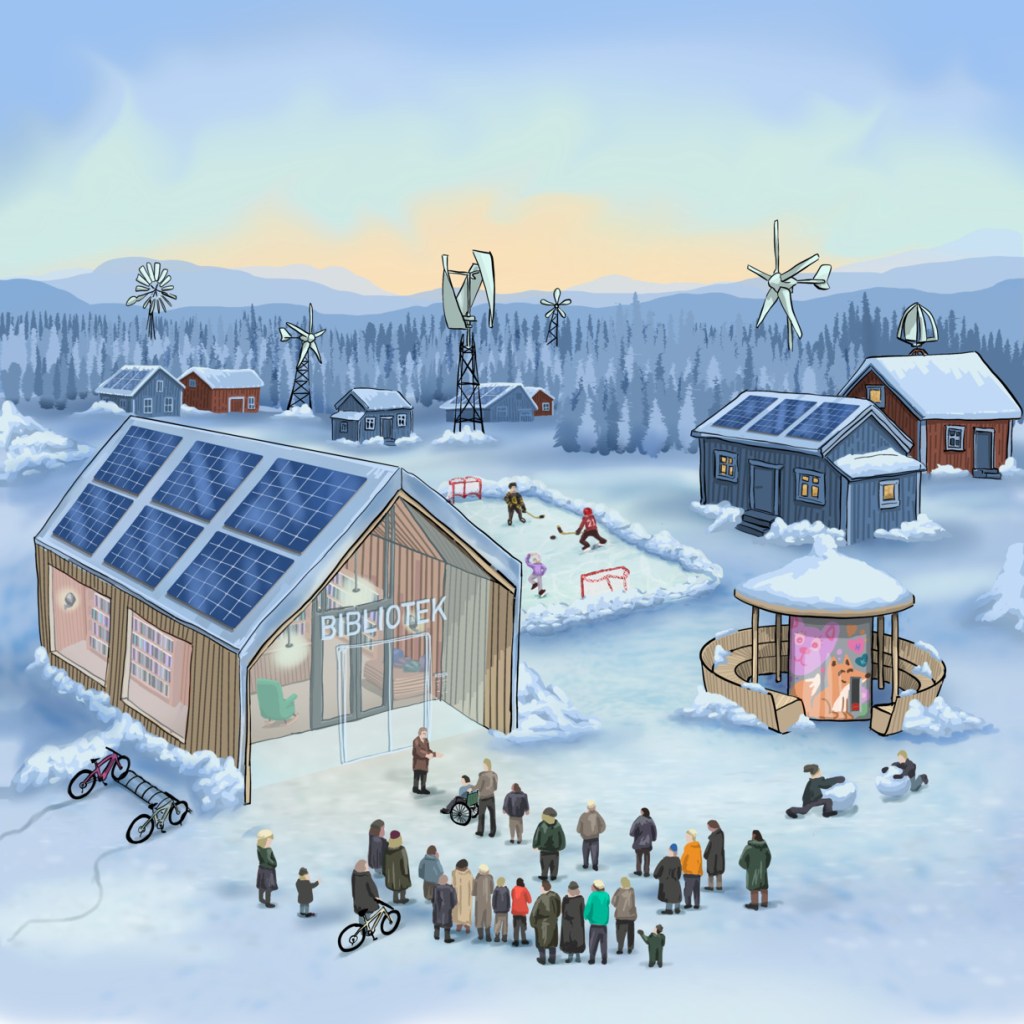
“The Stillout” features a small, wind-powered village trying to maintain its energy reserves through an extended windless calm in deep winter. It’s a story of community tensions, resilience, and solidarity during a different kind of ‘climate event.’
Astrid thought about that for a while, the fog of her breath hanging in the still air. “I don’t think so,” she said eventually. “The way my aunt put it, there’s sky energy and earth energy. Sky energy—wind and sun—can be fickle and inconsistent, but it’s clean and lasts forever, if we’re willing to work with it, to adjust ourselves a bit to the rhythms and moods of the world. Earth energy, on the other hand—those fuels we dig out of the ground—it bends to our will, making itself terribly convenient, and then bends us to its will. It comes with a terrible cost, one that must be paid for generations. I think I can take a couple weeks of inconvenience, if it means not leaving a mess for my grandchildren.”
Spring Fires Day

“Spring Fires Day” explores a beautiful, greenhouse-covered city celebrating the coming of spring with the traditional moving of solar panels back onto roofs. However, political and familial tensions complicate this community ritual, as future generations start to have their own ideas about the environment and the energy transition.
There was a moment then, when Hugo’s grip slipped, perhaps still a bit soapy, and Max, who was standing well back, envisioned the panel crashing to the ground. In that moment, Max thought of the whole life cycle of a panel, the materials from the mines, the manufacturing process, the supply chain, the vast dumps in China and America where mountains of broken and obsolete panels were discarded, which his teacher had shown them in class. And yet, despite all that, the panels produced more energy than they consumed, powering Max’s school tablet, his reading lamp, their oven and fridge, flowing into the city’s grid to charge buses and bicycles and everything, all things they needed. In that moment, it seemed too impossible and overwhelming that this should be how the world worked. Not just for solar panels but for shoes and coats and electronics and batteries and toys and everything. Everything made and thrown away, and no matter how much they reused and recycled still the mines would get deeper. How could the world live with this? And what other way to live could there possibly be?
I am so excited to have this officially book out in the world, and so thankful for my colleagues who helped inspire these stories and bring them to life. Thanks as well to our funders: LTU, RI.SE, Vinnova, and the stakeholders in the Arctic Center for Energy.
 Andrew Dana Hudson