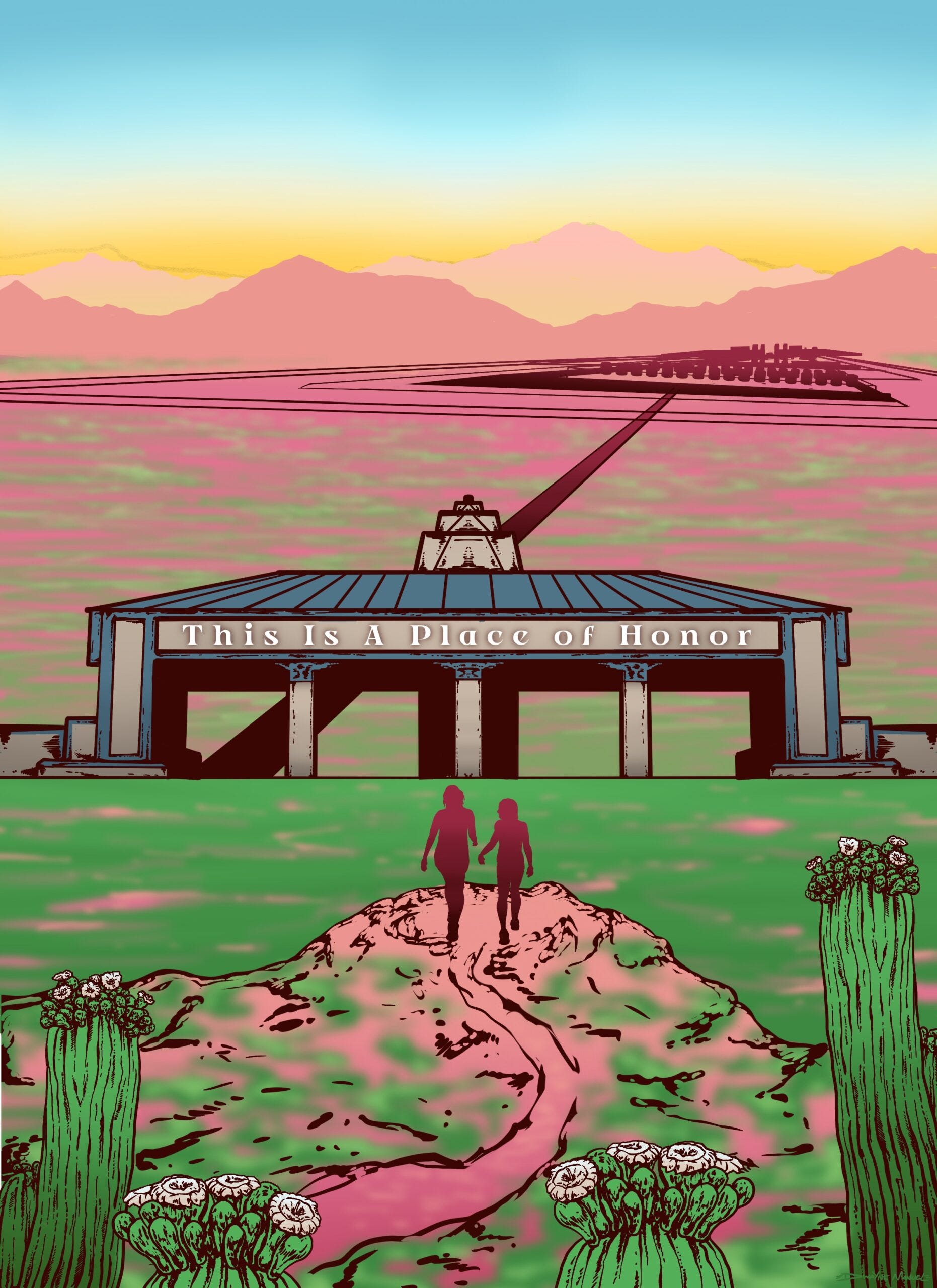
Art for “Pursuant to the Agreement” by Dwayne Manuel
In spring of 2024, I participated in a narrative hack-a-thon put on by my friends at ASU’s Center for Science and the Imagination. The gist of a “narrative hack-a-thon” is that you get a bunch of interesting thinkers together, with various expertise, you team them up with SFF writers, and you have them brainstorm a sci-fi story on a particular topic or question. This workshop asked us to come up with stories about the messy, historically fraught question of what the US should do with its nuclear waste.
The story I eventually wrote up is titled “Pursuant to the Agreement.” It’s an epistolary story, documents framed as a series of exhibits at a future Museum of the American Fracture. You can now read it in the book Our Radioactive Neighbors, edited by my colleagues Clark Miller, Ruth Wylie, and Joey Eschrich. The volume also includes stories by Justina Ireland, Carter Meland, and my friend and fellow solarpunk Sarena Ulibarri. This fiction is supplemented by about a hundred pages of essays explaining and exploring the mechanics of nuclear power, the history of NWM and siting policy, the complexities of seeking community consent. It’s all extremely thoughtful and informative. If you ever wanted to be able to impress your friends at dinner parties by mastering a grim and arcane but genuinely fascinating topic, well, this book could probably get you most of the way there!
There is also a really nifty supplemental facilitation guide featuring questions and activities that can be used to start conversations about the stories. Part of the role of the book, used in the larger 3CAZ series of community forums, is to help communities develop the imaginative capacities required to make hard collective decisions.
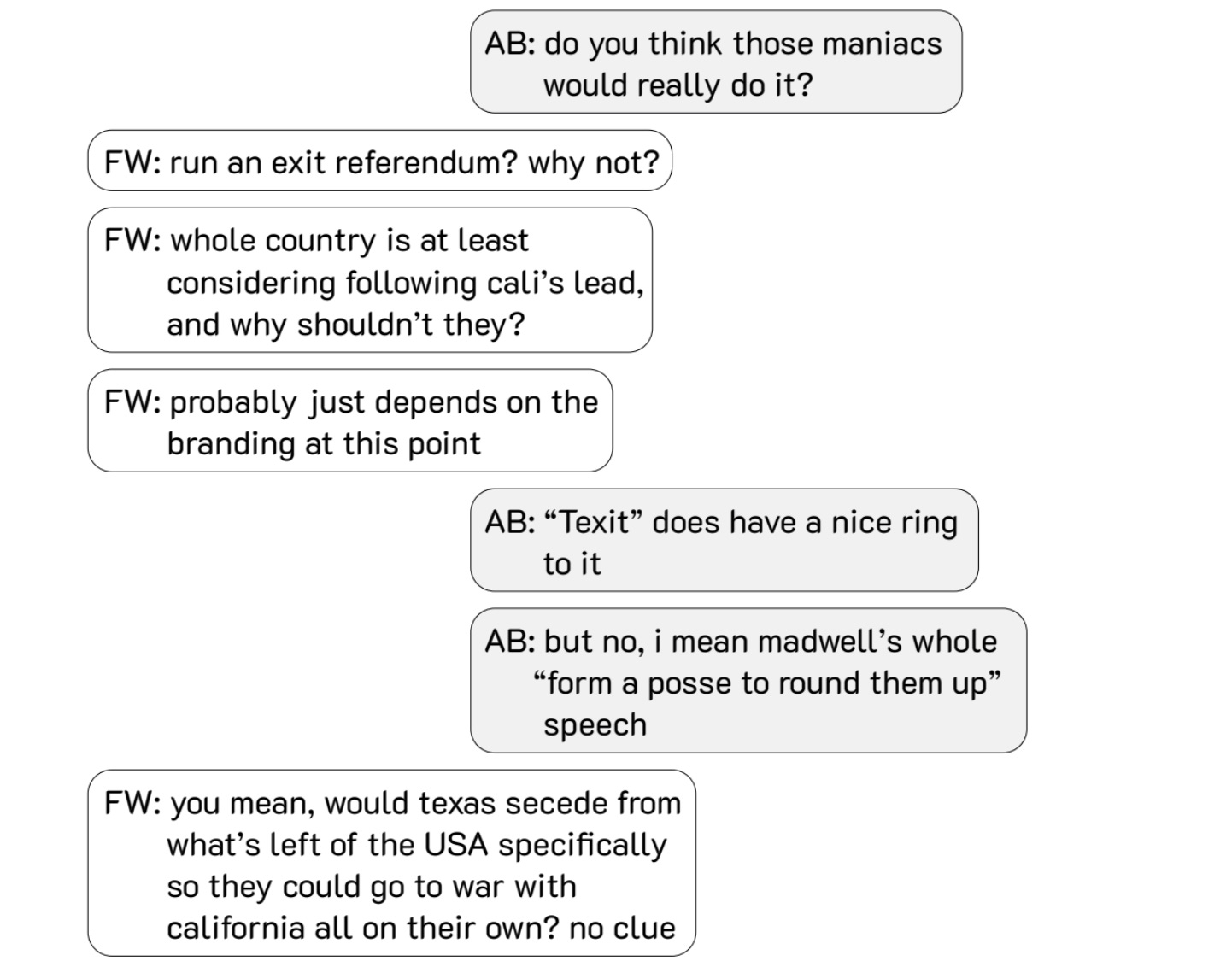
Here’s a snippet from “Pursuant,” from right around the middle of the story:
“Pursuant to the Agreement” sprawls across decades and generations and text genres. It features official documents, diplomatic communiques, text message conversations (see above), meeting transcripts, handwritten letters, and fuck-you emails, all held together with curator’s notes that give a 22nd century perspective on 21st century institutions, expectations, and foibles. It’s about trying to hold together a long-term project across an ever-shifting policy landscape and an ever-swinging political pendulum — in this case one swinging wildly enough to break its moorings and go careening off over the historical unprecedented horizon. Which, you know, relatable.
Rocky Cornelius — uncool hunter, concept shoppe soft-launch defender, action-business guru extraordinaire — is back! Her latest adventure, “The Love Pyramid: A Rocky Cornelius Consultancy,” returns the Escape Podpodcast to a capitalist surrealist future rife with collapse, violence, sex, and cross-platform branded content. This time Rocky is doing throuples therapy for a romantically confused trio of multiformat creatives…
“Here’s the deal,” she said. “You make love triangles, but what you’re actually selling is a love pyramid. In the eyes of your followers, your characters’ three-way relationship is intriguingly mirrored by your own, creating a three-dimensional fandom hyperobject. For these stans, the point of Planet Complicated isn’t to simply enjoy each episode, but to speculate, to scrutinize these connections, to hold this prism up to the light and see how things refract.
“They want to know, are you, Hill, actually the inspiration for the inscrutable Captain Gorges? Are you, Tam, the sensitive alien bounty hunter Radnar, and you, Edna, the unpredictable masc-femme fatale Silcira? Or have you remixed the dynamics to throw fans off the scent?”
Rocky is in the midst of making her pitch when an unfortunate drone strike brings their private jet crashing down toward a Dallas golf course.
Now, Rocky Cornelius was not exactly a spiritual person. She had no use for the peasant religions of old, nor the megalomaniacal self-worship of the plutocrats. However, she’d had a formative experience with death, while attending a cacao-fueled heart-sharing-slash-networking circle with her mother.
Sitting there under the high, dim lights of the venerable Kay Bailey Hutchison Convention Center, Kim Cornelius beside her learning to let go of fear in the face of uncertain market conditions, eight-year-old Rocky felt a hairy hand come down hard on her shoulder. The middle-aged entrepreneur to her right was clutching his chest and, over the next few minutes, died in what seemed to be tremendous agony.
In those moments, young Rocky had felt intimately connected to her own mortality. She’d made gleeful peace with the fact that she was going to die, including the likely possibility that she would go out loudly thrashing. She might burn/drown in a fire/flood or get trampled at H-E-B in an egg panic or any of the other grisly fates she was used to seeing on her iPad. That would be okay, she’d decided. She could live with death.
But, at the same time—for reasons that emerged from an unspoken objection in the very foundations of her being—she also swore an oath: under no circumstances would she allow herself to die in the state of Texas.
So as the Cessna plummeted and her clients wailed and the pressurized cabin air whistled out of fresh holes in the fuselage, Rocky couldn’t help but lift her head and fixate on the particulars of the geography rushing up toward them. Much was obscured by the grim-gray mass of the polar vortex. To the south, however, was a telltale slate-brown smear of exurbia. That could be Oklahoma, but who was she kidding. That was Dallas. Soul-sick, world-killing Dallas, once the red heart of the American death drive. Which left Rocky no other option.
She’d have to survive.
Will Rocky be able to keep her clients alive amid a deadly freeze-front AND sort out their friendship-straining sexual tension AND find out who shot down the jet AND confront the ghosts of her own fraught Texan past? The only way to find out is to read or listen to “The Love Pyramid: A Rocky Cornelius Consultancy” (also available wherever you get your podcasts)…
As I’ve discussedpreviously, Rocky and her satirical future have been a way for me to capture and extrapolate on a certain frenetic nihilism I see in our market-dominated world. But, also, draw out the current of humanity that still bubbles under the layers of technological, economic, cultural, and narrative abstraction the billionaires are keen to bury us in. The first draft I did of this story was a bit darker, seeing no redemption possible for the Lone Star State. (Stephen King, in his JFK assassination novel 11/22/63, implied that Dallas is a more cosmically evil place than Derry, the town he himself had made up with, among other problems, an immortal killer clown.) But that version just didn’t work. I think that no matter how bad times get, we have to believe that our subjugation — to the logic of capital or fascism or any other mode of dehumanization — will always be slipping, always incomplete. If even an avatar of such market logic like Rocky Cornelius can have feels about her mother while tromping through a blow-out Denton County exurb, there’s probably hope for all of us.
A few miscellaneous notes about this story:
“Bosto-Californian private school kids” Edna, Tam, and Hill were loosely inspired by the trio in Tomorrow and Tomorrow and Tomorrow by Gabrielle Zevin, just with a dash more will-they-won’t-they thrown in.
Thank you to Michael Burnam-Fink for his valuable contributions to my conception of Rocky’s emotional arc in this story.
And apologies to Bruce Sterling for appropriating his character Leggy Starlitz (see Bruce’s classic novel Zeitgeist, as well as a handful of his shorts). But, frankly, Leggy came to me, and he made a very compelling proposition. Here’s hoping he doesn’t make too much trouble in Rocky’s world…
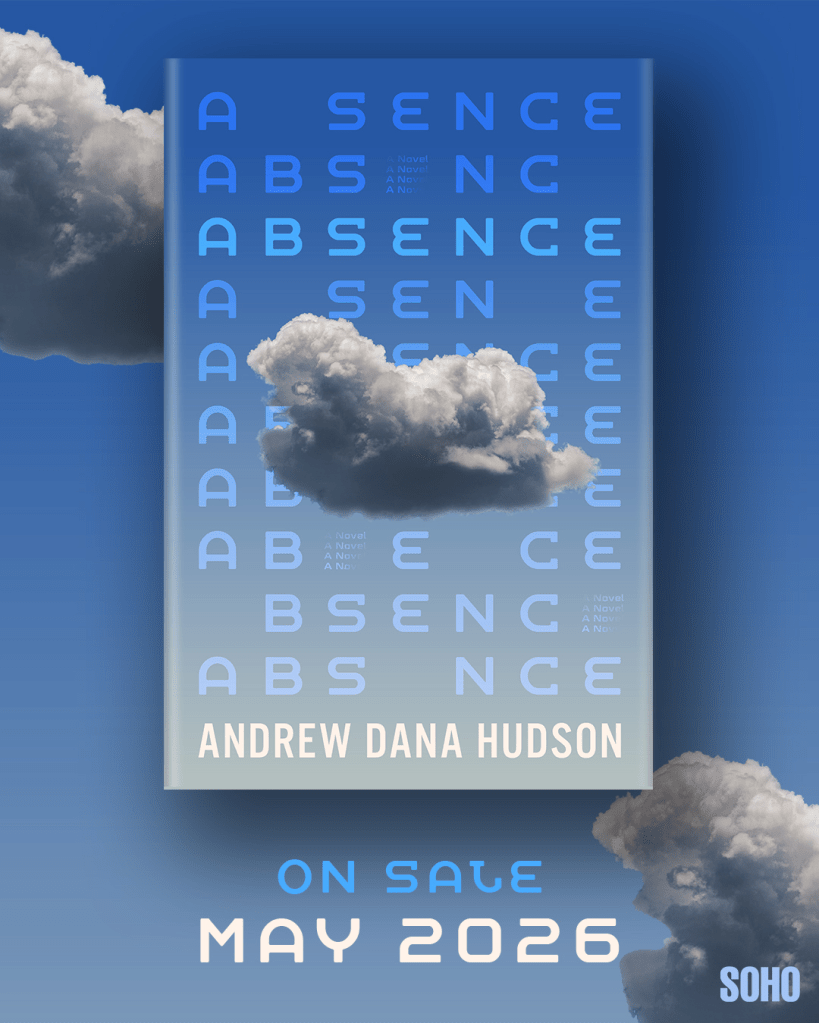
My next book is coming, and we’ve now revealed the lovely cover! I love the mood and the disappearing letters motif, which (spoiler) is also used in the gorgeous inside design.
DESCRIPTION:
In this moving, richly detailed speculative crime debut, the world is unraveling from an epidemic of human vanishing. Two novice investigators are dispatched to small-town Kansas to interview a woman who claims to have returned from Absence, offering answers to everything.
People are “popping,” disappearing one-by-one, into thin air: an ongoing global cataclysm known as Spontaneous Human Absence. In a world where prospects for survival are increasingly grim, hopelessness prevails, political rifts widen, and doomsday predictions flourish.
Harvey Ellis works the night shift for the Bureau of Depopulation Affairs, an ad hoc federal agency meant to contain and catalog the crisis. His job: to investigate claims of Absence, and, if validated, issue a standard government stipend to boost morale. Still recovering from losses of his own, Harvey is content in his routine—until his life is shaken up by an unexpected assignment from the central office.
A woman long thought Absent has reappeared in her hometown of Dawnville, Kansas, claiming she’s been to the other side and back. Is her story true, or is she just the latest false prophet, offering hope to a world desperate for answers? Together with his no-BS partner Shonda Erins, Harvey travels to Dawnville to find out.
A sweeping portrait of a world beset by confusion and dismay, Andrew Dana Hudson’s debut novel is a vividly imagined speculative mystery of cosmic proportions, examining the stories we tell to get by.
Esteemed neighbors, emissaries, ambassadors, and dignitaries, I write to you today not only as a statesman but as a scientist.
We in the city of Omelas have been exceedingly lucky in recent years. The wars, diseases, and financial instability that have rocked the world have so far passed us by. Partly that’s been due to prudent precautions and smart public investments, but it’s also true that our fine city benefits in unique ways from ancient, dearly-held customs.
This story is my contribution to a minor SFF tradition: the Omelas response story. “The Ones Who Walk Away from Omelas” is a classic 1973 story by Ursula K. LeGuin — in my opinion the greatest SFF writer of all time. LeGuin’s story describes a utopian city in vivid and thoughtful detail, and then reveals that, according to its inhabitants, this utopia’s wellbeing rests on the continuous suffering of a single, innocent child.
It’s a thought experiment of immense ambiguity. Is this apparent moral compromise acceptable? If not, what should one do about it? LeGuin leaves such questions as an exercise to the reader, and exercise they do. Over the last half century, “Omelas” has provoked many classroom discussions and essays and social media jokes.
It has also provoked other stories. Something about this story just makes writers want to parody or pay homage or otherwise riff on LeGuin’s core conceit. There’s N.K. Jemisin’s “The Ones Who Stay and Fight” about trying to fix injustice instead of simply walking away. There’s P.H. Lee’s “A House by the Sea” imagining the adult lives of the suffering children. There’s John Holbo’s take on Omelan tourism. There’s Isabel J. Kim’s excellent story from a year ago, “Why Don’t We Just Kill the Kid in the Omelas Hole.” My friend LP Kindred had a story in which the kid was instead a captive god, who is rescued by his lover. There was that Star Trek: Strange New Worldsepisode that borrowed the Omelan conceit. Heck, I’m told there’s even a BTS video.
I myself have written a bit about Omelas on my newsletter before, coining the idea of “Omelian thinking” — the tendency to assume that better worlds or utopian futures must be the result of some horrible moral bargain.
And now I’m back with my own response story, “An Omodest Proposal” — the title of course a reference to both “Omelas” and Jonathan Swift’s famous satire “A Modest Proposal.” In this piece I don’t try to countermand LeGuin’s thought experiment (though I do, if the narrator is to be believed, settle one aspect of the ambiguity). Instead, I extend the scope. What would you do if Omelas offered to annex your town, fix all your society’s problems, give everyone a utopian lifestyle of peace and joy? How does expansion change the utilitarian calculus? Is utopia still utopia if it’s not an exception but the rule, if it’s everywhere, if it’s an empire?
Like all good Omelas stories, it’s a little bit wistful and a little bit mean. I hope folks find it a worthy addition to the genre.
It feels odd to write about utopias when in reality we are careening at top speed in the opposite direction. The evil in Omelas (if indeed you think there is one) is a subtle one: an evil of compromise, of ‘greater good’ calculations, and also of apathy and cowardice. An evil of turning away. The evil now trying to tear apart the fabric of American society is not subtle at all. It’s brutish and noisy and brazen. The worst, most hateful and selfish and stupid people in the country are presently performing an oligarchic coup. They are doing away with the inconvenience of American democracy in order to put uppity workers and women and minorities back in their place. They told us they were going to do this, and people elected them anyway, but it’s still a coup. Very likely we are in just the first moments of a long reactionary rampage. We’re so, so far from utopia this week.
Still I do think there’s a parallel to be drawn. My story attempts to trace the way that, left unchecked, small evils get ambitious. If you normalize them, they will keep taking an inch, and then a yard, and then a mile. They’ll turn imperial. That’s what happened in America. Whether due to fascination or exhaustion or ignorance or indifference, we let the forces of fascism and reaction carve themselves a place in our polity. We turned away or walked away or just went on with our lives. We let this nasty little darkness fester. We let them get away with it. And now we’re reaping the consequences.
So if you see cops or border patrol or fashy-looking guys hauling some kid through the streets, toward a basement, or an ICE bus, or detention camp — don’t walk away. Don’t believe them when they say they’re doing this for your benefit, for the greater good, for ‘common sense.’ Because pretty soon they’d like to haul off your neighbor, or your coworker, or you. It won’t just be the one kid.
That’s a lesson, perhaps, of my new short story, “The Weather Out There,” published in Long Now Ideas, the publication of the Long Now Foundation, whose mission is to encourage long-term thinking. It’s also possibly the lesson of the long journey this story had to finding a home. I first drafted this story seven(!!) years ago. That’s a long time to hold a candle for a story, but I really liked it, and so I never quite buried it in the trunk. In the years since it’s been through many revisions and rewrites, ballooning up to 10k words and back down to 3k. Then I pitched it to Long Now, and they took it right away. Of course an organization focused on long-term thinking would be the right place to publish this story about conversations that play out over centuries, messages traveling for decades through the murk of deep space.
This story is set is the Bay Area over a thousand years from now. For a good chunk of that future time, people have been in communication with an alien civilization, the Alsafi, some 19 light-years away. There is no ansible in this story, no FTL, no way around the cosmic speed limit. If you had a question for the aliens, you’d have to wait about 40 years for an answer. It’s a slow conversation, but one that makes humans appreciate their environmental sustainability and organizational/cultural continuity. Until, one day, the Alsafi go silent.
The story follows Ferris, who works on the teams that send messages across the void, recording his thoughts in a journal that comes with his ancient Oakland house. As he tries to puzzle out what happened to the Alsafi, he rekindles a relationship with an old flame, Cassio, and, well, things get complicated.
Here’s an excerpt:
“Say there’s a lighthouse out there.” Cassio waved towards Marin. “It’s going to blink a message at you. What are all the things that have to go right for you to get that message?”
“You have to have line of sight,” I said. “And be looking in the right direction, at the right time. You have to be watching long enough to see the whole message, and you need a good enough memory to remember the pattern. Then you have to know how to decode it.”
“And,” Cass waved expansively, “it can’t be too foggy.”
“We’re pretty good at predicting the weather out there, you know.”
“I’ve never liked that metaphor. Tracking matter a dozen light-years away is nothing like watching for clouds on the horizon. It’s dark, and your model has to look decades ahead based on the thinnest flickers of shadow. Did you know they keep changing the estimates of how much dark matter there is in the universe?”
I did, but something about being there with her, on that beach, stirred a thought I hadn’t had before.
“In the histories the Alsafi used to wonder a lot why they never heard from anyone besides us,” I said. “They’ve always been more bullish about the chances of life in the universe.”
“You think if they got a transmission from someone else, they’d stop talking to us?” Cassio asked.
“A second contact changes everything about The Conversation. Do they tell us about them, or them about us? Whose permission do they need first? Who do they prioritize? It gets complicated.”
“Kind of like us,” Cass said.
She spoke low, barely louder than the surf. We let it hang there for a moment, the chimes of distant drift-ships rolling in and out of the Golden Gate.
“Kind of like us,” I agreed.
Long Now published this alongside reprinting my solarshades.club essay “Space is Dead. Why Do We Keep Writing About It?” This piece proposes that the huge amount of sci-fi written about spaceships, colonies on faraway planets, galactic empires, and daring astronauts might be out of sync with the sluggish or nonexistent progress we’ve made over the last 50 years toward such a spacefaring future. If we want to find out what’s out there in the universe, I argue, we first need to figure. out how to survive here on Earth.
Very pleased to announce that my next novel has been acquired by Soho Press. Tentatively titled Absence, it’s a cosmic mystery about trying to make the world make sense in the face of unprecedented times. It’s a chunky, fast-paced, supernatural thriller, and I can’t wait for you all to get to read it.
Here’s the official announcement in Publisher’s Marketplace:
My brilliant, amoral capitalist-surrealist trickster character Rocky Cornelius is back! Last time around, in “The Uncool Hunters,” Rocky slugged it out with her nemesis while doing market research in an Illinois CostCo. This time, we get to see her work her creative consultant magic, helping with the soft-launch of a peculiar concept shoppe. What’s a ‘concept shoppe’? I’m so glad you asked.
The idea of this ‘concept shoppe’ was to make shoppers feel like they were looting an abandoned store in a post-apocalyptic, collapseporn paradise. Rocky quite liked the idea. No one wanted to be a ‘consumer’ these days. People—especially Californians, who had lately been through so much—wanted to think of themselves as ‘survivors,’ as disaster-hardened protagonists in a return-to-their-roots story of rebuilding and social rejuvenation. It’s just that, if they could afford one of the new quake-proof condos springing up in Westwood, they wanted to do so without having to worry about tetanus, botulism, scurvy, or gluten.
The soft-launch goes swimmingly until things get a little too post-apocalyptic. To find out what the trouble is, you’ll have to read it, but I’ll give you this little taste of Theme Stated:
“But—” Franklyn began, but Rocky slapped him hard across his blond-bearded face.
“Snap into it!” she said. “You wanted The Event? There is no single The Event. Catastrophe isn’t evenly distributed and never will be. Some folks will get knocked back to the stone age, while others will keep on as sales reps and foot models and costume designers. Some will go greengrocer and others will go bandit. This here is your The Event! So get to it!”
I wrote in my newsletter about some of the themes behind this story, and how I accidentally tapped into my inner Le Guin when setting this story up in “The Uncool Hunters.”
In 2023 I spent almost half the year living in Northern Sweden, working on a project at Luleå University of Technology. The project involved a series of narrative hack-a-thons, which then inspired four climate fiction stories about the future of energy in the region. Soon there will be a full book, which will include nonfiction companion pieces, but as of now you can read them (and see the lovely illustrations by Daniel Bjerneholt) on the Luleå University of Technology (LTU) website here.
Here’s a quick breakdown of each story, with the corresponding illustration and a short excerpt:
“Windy City” is set in a bustling and prosperous far north metropolis, where wooden skyscrapers look out on giant wind turbines that are also significant tourist attractions. The story is a summertime caper about two moms trying to game a highly financialized energy system — and getting caught up with a rowdy separatist movement as a result!
Way the Bothnians figured, they’d built the huge wind parks and the next gen hydroelectric plants, not to mention the green steel used in the construction. Why should Stockholm suddenly get to claim the fruits of their labor—especially when (and this was a popular grumble) the same politicians now calling for an emergency transmission blitz had spent years blocking a high speed rail connection between Skelluleå and the south? Why countenance a fresh round of extraction, when they could instead join forces and cultures with their comrades across the water, who had worked with them to pull the continent—indeed, the world—out of the climate death spiral? Didn’t the more robust grid connections laterally to Norway and Finland mean something? A shared destiny perhaps?
“The Wild Tour” has the north returning to its traditional role as a landscape of extraction to benefit Stockholm and the rest of southern Sweden — while also returning land to the long-marginalized indigenous Sami people. Fall-winter is setting in, and a bloody animal encounter beneath cable-tethered turbine balloons leaves a loner in the debt of some itinerate turbine workers who want to see the real, post-rewilding north.
It always took Anders a minute to adjust his forest eyes to the scale and weirdness of a tetherpark, and so he noticed too late the round, mottled forms rapidly closing on him. They came out from behind one of the anchor blocks, four of them, and rushed with surprising loping speed for his legs, sharp teeth eagerly bared, faces a picture of kawaii cuteness. They only came up to his knee, but after the long summer feeding season they had packed on fat. Each one would easily bowl him over, crush him under its soft, cuddly belly.
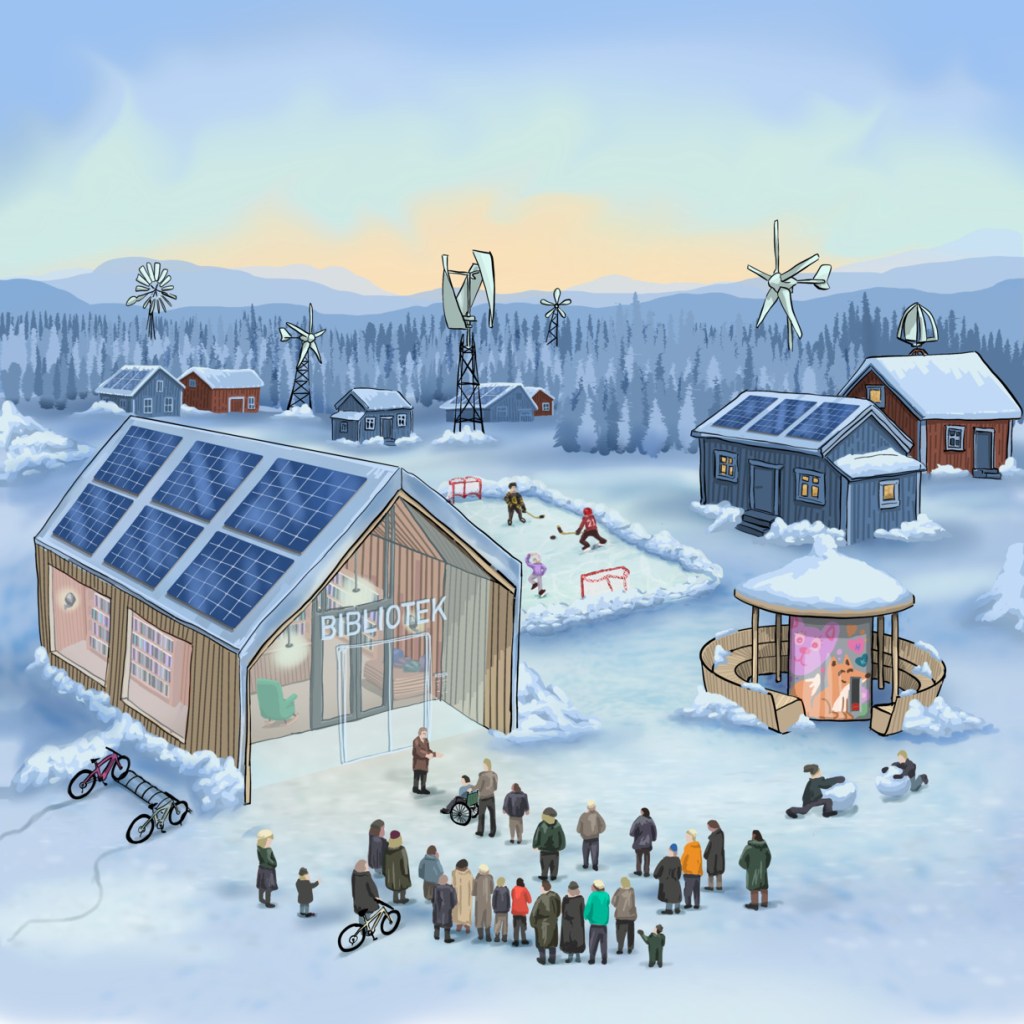
“The Stillout” features a small, wind-powered village trying to maintain its energy reserves through an extended windless calm in deep winter. It’s a story of community tensions, resilience, and solidarity during a different kind of ‘climate event.’
Astrid thought about that for a while, the fog of her breath hanging in the still air. “I don’t think so,” she said eventually. “The way my aunt put it, there’s sky energy and earth energy. Sky energy—wind and sun—can be fickle and inconsistent, but it’s clean and lasts forever, if we’re willing to work with it, to adjust ourselves a bit to the rhythms and moods of the world. Earth energy, on the other hand—those fuels we dig out of the ground—it bends to our will, making itself terribly convenient, and then bends us to its will. It comes with a terrible cost, one that must be paid for generations. I think I can take a couple weeks of inconvenience, if it means not leaving a mess for my grandchildren.”
“Spring Fires Day” explores a beautiful, greenhouse-covered city celebrating the coming of spring with the traditional moving of solar panels back onto roofs. However, political and familial tensions complicate this community ritual, as future generations start to have their own ideas about the environment and the energy transition.
There was a moment then, when Hugo’s grip slipped, perhaps still a bit soapy, and Max, who was standing well back, envisioned the panel crashing to the ground. In that moment, Max thought of the whole life cycle of a panel, the materials from the mines, the manufacturing process, the supply chain, the vast dumps in China and America where mountains of broken and obsolete panels were discarded, which his teacher had shown them in class. And yet, despite all that, the panels produced more energy than they consumed, powering Max’s school tablet, his reading lamp, their oven and fridge, flowing into the city’s grid to charge buses and bicycles and everything, all things they needed. In that moment, it seemed too impossible and overwhelming that this should be how the world worked. Not just for solar panels but for shoes and coats and electronics and batteries and toys and everything. Everything made and thrown away, and no matter how much they reused and recycled still the mines would get deeper. How could the world live with this? And what other way to live could there possibly be?
These stories grew out of a series of “narrative hack-a-thons” about the future of the energy transition in northern Sweden. Northern cities like Luleå and Skellefteå have been embracing green industry and anticipating significant energy system and social changes as a result. People there are thoughtfully considering how to navigate those changes, including the influx of people they may bring. It’s a chance to reimagine what communities in the north look like and what the region’s relationship should be to the rest of Sweden.
These narrative hack-a-thons brought together scholars from a variety of disciplines, utility and municipal policymakers, students, and me. The explicit goal was to brainstorm possible future scenarios for the energy system and science fiction stories that could illuminate and complicate those scenarios. Many thanks to our partners and funders from the Arctic Center for Energy, Research Institutes of Sweden, Vinnova (the Swedish innovation agency), and of course LTU.
This is a methodology we largely based on similar projects I worked with the ASU Center for Science and the Imagination, which used such narrative hack-a-thons to produce the excellent solar futures books The Weight of Light and Cities of Light. The dimensions we used to guide our scenarios were the same ones used for the Weight of Light project: size of energy system units (big or small) and setting (urban or rural). However, our Sweden project did work slightly differently. Instead of having one workshop with four teams (each with a sci-fi writer that would write their own story), we had four workshops, each one with a unique set of participants. The only constants were myself and my LTU colleague/project mastermind Anna Krook-Riekkola, a brilliant energy systems modeler who made this whole thing happen.
We hoped that by having a single author (me) as a tentpole, we could make the stories more connected and comparative than the ones in the CSI books, which, while all pretty brilliant, don’t feel that much like diverging scenarios. We were shooting for a middle ground between those books and the highly comparative and connected scenarios stories in my book Our Shared Storm: A Novel of Five Climate Futures.
I think we somewhat succeeded in this, though we are still triangulating the perfect sweet spot. While the workshops were very generative, spreading them out over time and changing up the participants made it hard to do something as ambitious as create shared characters across the scenarios, the way I did in Storm. And the ideas that came out of the workshops had their own momentum that didn’t always fit nicely into a comparative framework. Also, for my own part, I found it hard to redo what I had done in my book, and instead looked for new creative and intellectual hooks to focus my attention on.
These four stories are all, to some extent, “predicting the traffic jam” stories. They look at the onrushing energy transition and imagine some possible complications in how we might feel once it’s through. There’s a certain melancholy to them. This was partly how I was feeling last year, coming out of the pandemic, moving across the planet to a new country, which wasn’t easy. It was also partly, I think, something I picked up on in Swedish culture and politics. I mean, check out this wild report from Kairos Futures, a consulting and research company I had the pleasure to visit with while in Stockholm: “Swedes, Daily Life, and the Darkness of Meaninglessness.” Oof!
Despite this, I personally think these stories are quite optimistic. In all of them, the energy transition is successfully accomplished, an enormous achievement. Their point is not that the energy transition is bad or should be avoided, a car that we would be better off never inventing. Their point is that we should remember that no transition is the end of history, that there will be new debates to argue over, always, in the decades and centuries to come, and that future generations will make up their own minds about the world they inherit.
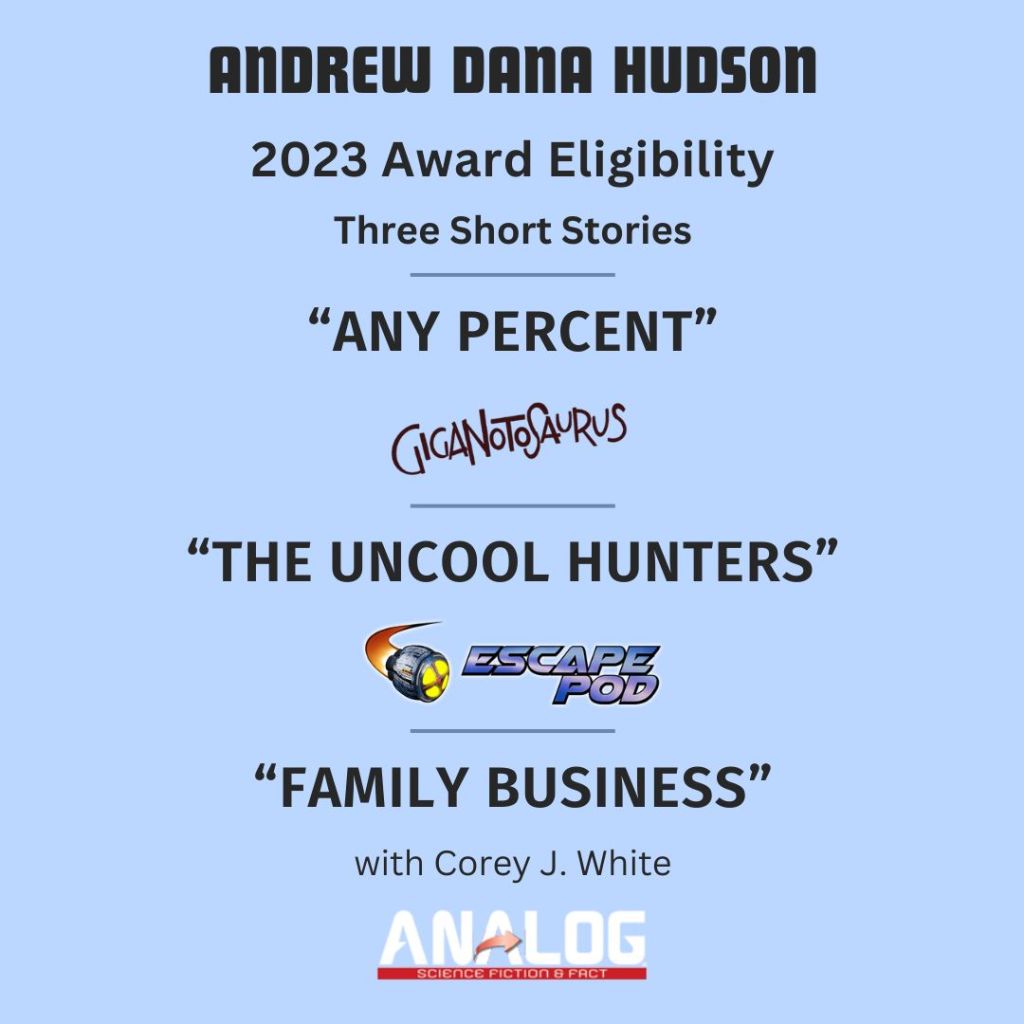
It’s been a long, busy year, and I’ve written a lot of short fiction and thought a lot about novels, but as is the way with publishing none of that is out yet. Instead I had three science fiction short stories come out, all written one or two years previously, all in great venues. I’m immensely proud of all three—though I think if I had to pick one “Any Percent” has my heart. If you participate in nominating for or voting in any of the SFF awards (the Hugos, Nebulas, Locus, etc.), I would be honored to have your support for my work.
A gritty cyberprole drama about speedrunning and solidarity in a video game where you can live any human life.
Mechanically, the way he did whenever he needed to escape the bleakness of IRL, Luckless daubed gel onto his temples, closed his eyes, and held START. When he opened them, her small, brown hands were stocking cans on grocery shelves. It was her birthday, of course, but she was mostly worried about when she’d find time to study for her GED, how late the buses were running after midnight, whether her mother had been sober enough to feed baby Diwa before bed. The algo in her earbuds beeped at her to pick up the pace.
Normally, Luckless would drop the can, shed the earbuds, steal a car, and head to the nearest skip he could remember. Tonight she was in Columbus, so Ohio Truck Skip wasn’t far. From there it would be routine to buy her way into the underworld, get a new identity that could make money moves, never have to do manual labor or think about where she came from ever again.
In her back, her feet, her arms, she felt that deep-bone tired. The same tired Luckless felt every day of that one, unskippable life.
She finished work and rode the bus home, nursed her baby, and slept. The next morning she got out early, went to the diner across from the grocery, where a few of her coworkers were gathering to talk about organizing a union.
A fun, ‘high capitalist‘ comedy caper about two creative consultants duking it out in an Illinois Costco.
Before she settled down into publishing in Minneapolis, before she got taken for a ride by the Chicago AltNormLit scene, before she flared spectacularly out of Silicon Alley, and had her pilot shoot C&Ded by the City of Santa Barbara, and narrowly avoided cryptocollar prison in the floodzone formerly known as Tampa, Rocky Cornelius was a fucking uncool hunter.
A multigenerational dramedy set in the climate repair industry—featuring carbon offset scams, ancestor AIs, and striking dolphins.
“Why not send some drone submersibles down there to check the seals ourselves? The only reason we use dolphins is because Aunt Eudy was an absolute freak.”
“Well, zir, that is the other piece of bad news. Our subcontractors did send drones. But, you see zir, the dolphins destroyed the drones before they could reach the reservoir. I’ve seen the footage. They are…very violent.”
Rory got up and paced circles, their vat-leather Louis Vitton boat shoes squeaking on the polished wood.
“I’m not going to ask how,” they announced. “I really don’t want to know. What I do want to know is, where did they get these ideas? Who’s been salting these fishes?”
“Researchers, zir, working to advance interspecies cultural exchange. Apparently very few human concepts were of interest to the dolphins until the researchers tried explaining dialectical materialism.”
I have a short story out in the November/December issue of Analog Magazine! Co-written with Australian SF writer Corey J. White, “Family Business” is the story of seven generations of the Weathersmith family, charting their rise and fall and rise and fall in the carbon removal industry. It features offset accounting scams, undersea engineering, ancestor AIs, and messy family drama.
Here’s an excerpt from about halfway into the story, when Rory (5ish generations in) finds out their dolphin employees have gone on strike:
“Why not send some drone submersibles down there to check the seals ourselves? The only reason we use dolphins is because Aunt Eudy was an absolute freak.”
“Well, zir, that is the other piece of bad news. Our subcontractors did send drones. But, you see zir, the dolphins destroyed the drones before they could reach the reservoir. I’ve seen the footage. They are…very violent.”
Rory got up and paced circles, their vat-leather Louis Vitton boat shoes squeaking on the polished wood.
“I’m not going to ask how,” they announced. “I really don’t want to know. What I do want to know is, where did they get these ideas? Who’s been salting these fishes?”
“Researchers, zir, working to advance interspecies cultural exchange. Apparently very few human concepts were of interest to the dolphins until the researchers tried explaining dialectical materialism.”
If you want to hear me talk about carbon removal and climate repair as a real world prospect, I recently had a lot of fun going into it on the Pullback podcast here.
This is my second story I’ve published with CJW, but it’s actually the first one we wrote together. It’s also the first time either of us has been published in Analog, which is one of the biggest and most storied SF magazines out there. Super excited to have this story out there!
So please, give it a read by supporting Analog with a print or digital subscription (a year’s digital subscription is only $6!!). You may also be able to find copies in some bookstores——not positive but I think Analog is one of the SFF mags carried on magazine racks at Barnes & Noble. It should look like this:








 Andrew Dana Hudson